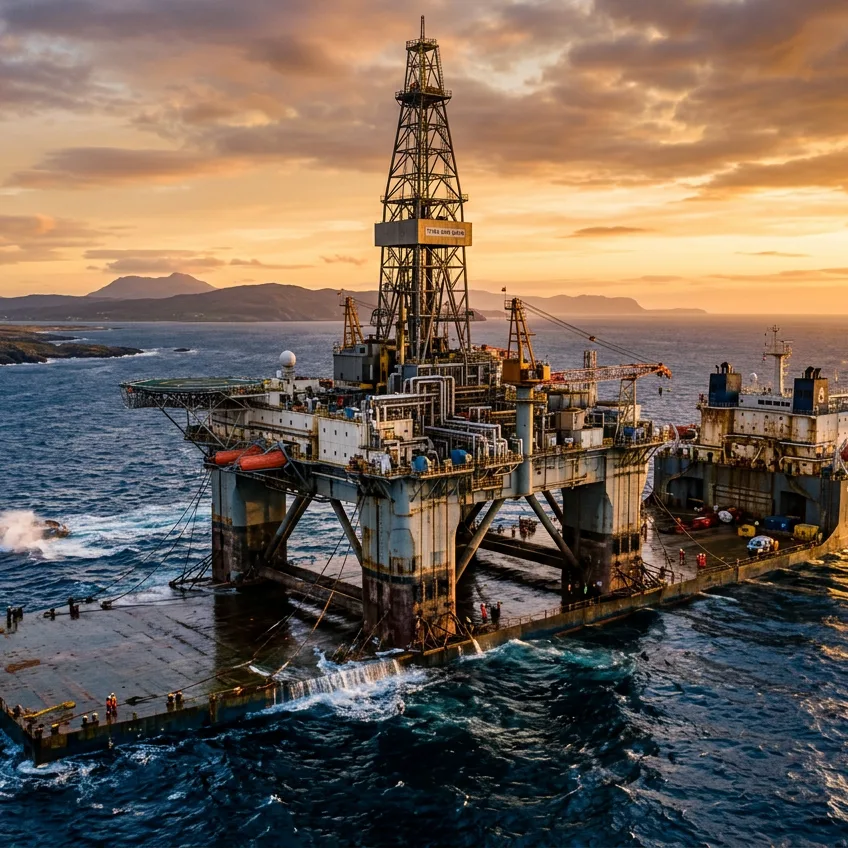
In May 1995, the coast of Norway witnessed one of the greatest feats of modern engineering: the maritime relocation of the Troll A gas platform. With a staggering height of 472 meters—surpassing New York's iconic Empire State Building—and a weight of 1.2 million tons ballasted, this gargantuan reinforced concrete structure holds the Guinness World Record for the heaviest object ever moved by human beings across the surface of the Earth.
Designed to withstand the relentless punishment of the North Sea for at least seventy years, the base rests on four hollow cylindrical legs of prestressed concrete that submerge more than three hundred meters beneath the sea surface. The challenge lay in the fact that such a colossus was not built in the open sea, but in a sheltered fjord in Vats. To transport it to its final destination 200 kilometers away, engineers had to float it by precisely controlling the internal water ballast down to the millimeter.
The journey required a fleet of ten of the most powerful tugboats on the planet, coordinated by satellite and cruising at a leisurely speed of barely one knot (less than 2 km/h). Over seven continuous days of absolute tension, the mass traversed narrow waters with safety margins of just a few meters before reaching its site. Once there, it settled onto the seabed, penetrating 36 meters into the underwater mud thanks to vacuum skirts built into its base, achieving titanic stability without the need for anchoring cables.
Source: Guinness World Records / Equinor Historical Archives