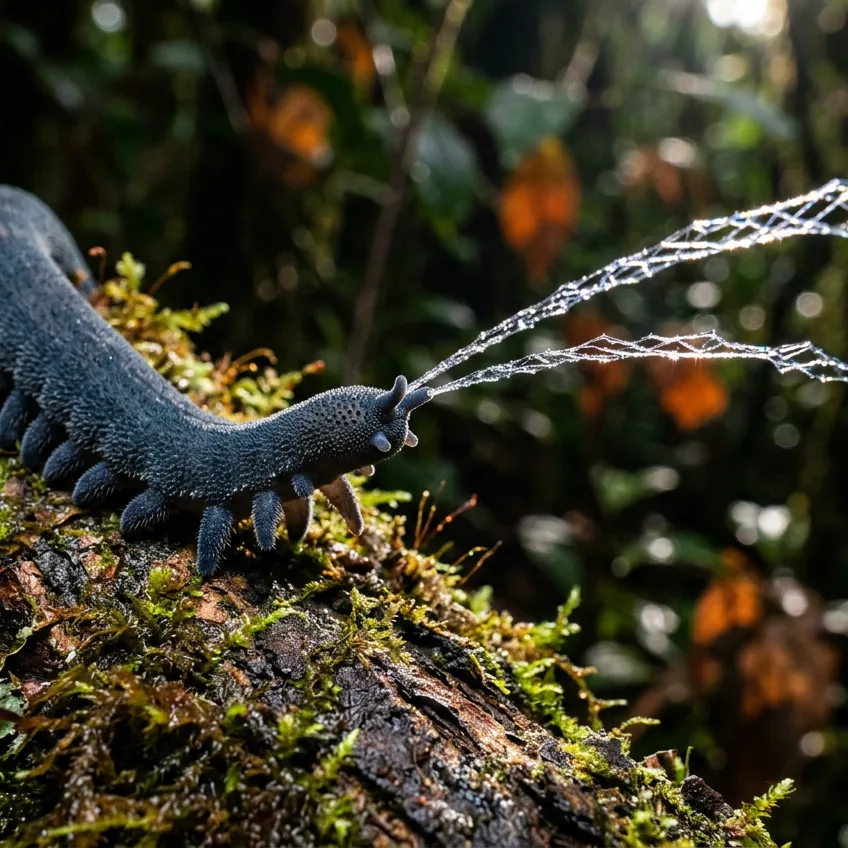
In the humid understory of tropical regions lives the velvet worm (phylum Onychophora), an unusual invertebrate that has barely changed in 500 million years. Far from being slow or defenseless, this primitive relative of arthropods possesses one of the most sophisticated ballistic hunting systems in the animal kingdom: two oral papillae capable of shooting jets of sticky slime at more than four meters per second.
What is truly remarkable about this attack is not only the composition of its ammunition, but the biomechanical physics that directs it. For decades, biologists wondered how a soft-bodied animal could shake its glands so quickly to weave a net in midair. In 2015, a multidisciplinary team discovered that the worm does not use active muscles to move the cannons: it relies on an elasto-hydrodynamic instability.
The process follows a millimetric choreography:
- Pressurized ejection: The worm compresses its internal reservoir, expelling fluid through elastic, bellows-like papillae.
- Passive oscillation: The liquid's own drag as it exits forces the nozzles to vibrate chaotically between 30 and 60 hertz, fanning out the jet into a perfect spray without expending muscular energy.
- Shear-induced solidification: The slime, rich in proteins and lipids, condenses instantly as the prey struggles, turning into rigid nylon-like threads in less than a second.
Once trapped and immobilized, the prey is digested alive thanks to enzymes that the worm injects before calmly sipping it.
Source: Nature Communications (Concha et al., 2015) - 'Liquid concretion and passive jet waving in velvet worms'