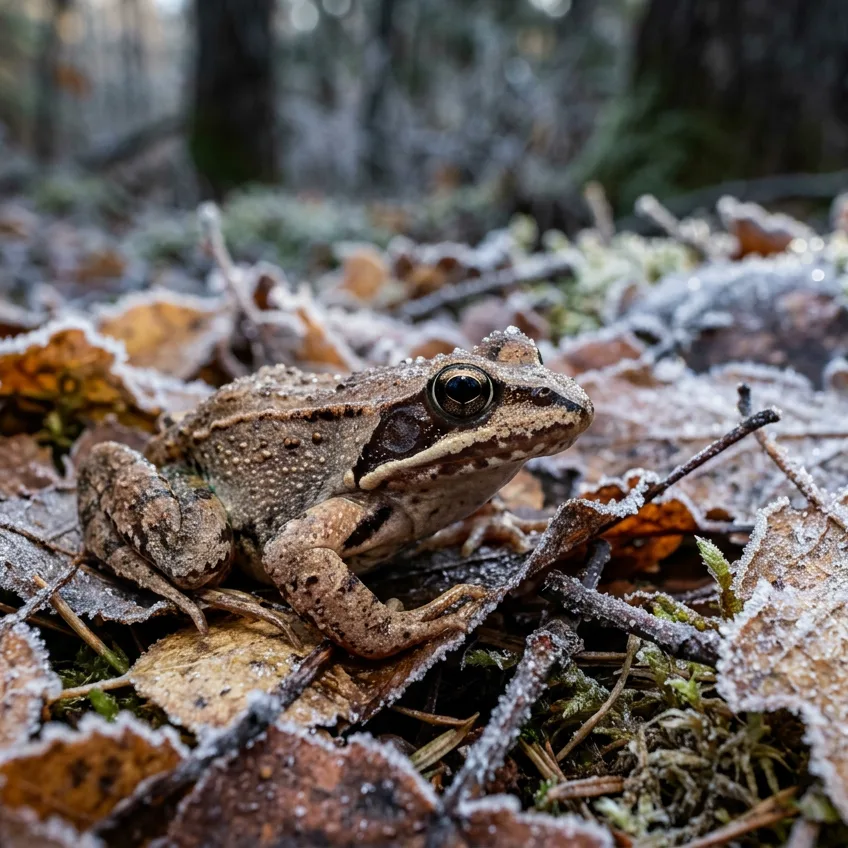
In the boreal forests of Alaska and Canada, where winter temperatures often drop below -15 °C, most vertebrates hibernate underground or migrate south. The wood frog (Lithobates sylvaticus) uses an unusual strategy: it lets itself freeze alive directly beneath the surface leaf litter.
As soon as the first ice crystals touch its skin, its body activates an extreme physiological cascade to prevent cell death:
- Hepatic cryoprotectant: In a matter of minutes, its liver breaks down massive glycogen reserves and saturates the bloodstream with astronomical concentrations of glucose and urea. This dense sugary solution penetrates inside the cells and acts as a natural antifreeze, preventing the cytoplasm from freezing and rupturing biological membranes.
- Controlled extracellular ice: Ice is not prevented, but redirected. Up to 65 % of the total water in its body freezes in the extracellular spaces, the abdominal cavity, and under the skin. The animal takes on the consistency of a rigid stone and its eyes turn opaque.
- Total biological shutdown: Its heart stops beating, breathing ceases, and recordings of brain activity drop to zero. For weeks and even months, the frog remains in a state indistinguishable from clinical death, with no blood flow or measurable oxygen consumption.
When spring arrives, thawing occurs evenly from the inside out. In a few hours, its heart spontaneously restarts without reperfusion damage and the frog resumes hopping normally. This mechanism generates huge interest in biomedicine to extend the preservation time of human organs intended for transplantation.
Source: Journal of Experimental Biology (Costanzo et al., 'Extracellular ice nucleation and freeze tolerance in wood frogs')