In the mid-1960s, the construction of the World Trade Center in Lower Manhattan faced a colossal geological dilemma: the ground where the Twin Towers would stand was not solid rock, but artificial fill reclaimed from the sea and completely saturated by the waters of the Hudson River. Excavating seven subterranean stories for the foundations threatened to trigger a catastrophic collapse and the immediate flooding of the entire financial district.
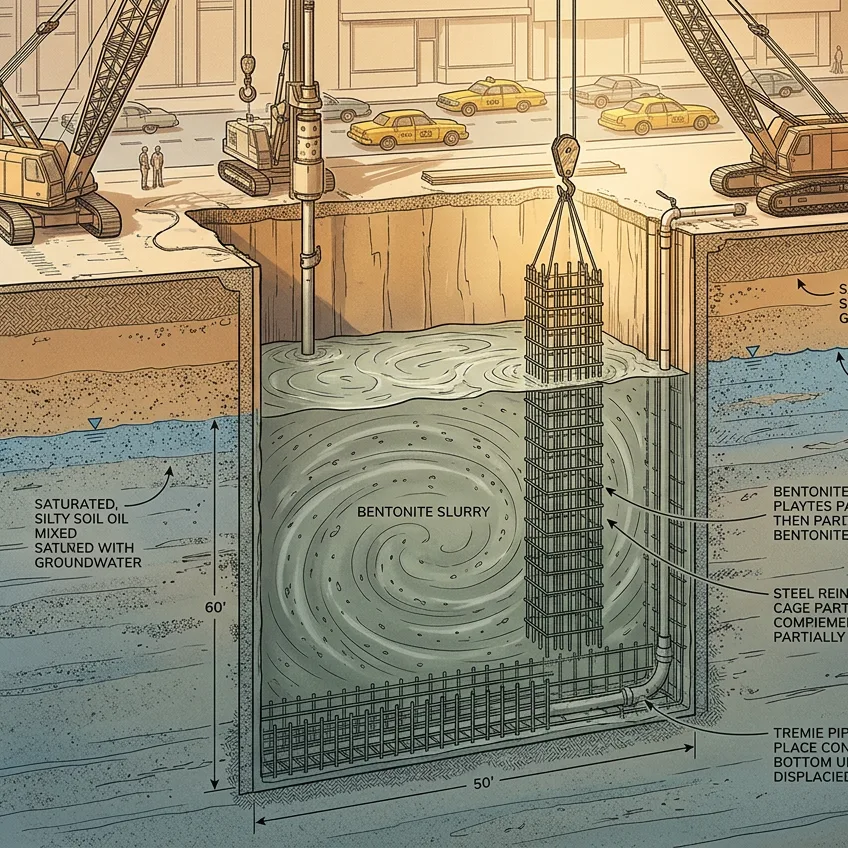
To solve this hydrogeological nightmare, engineers turned to a European technique barely tested at such a scale: the slurry wall with bentonite mud. The work was carried out through a fascinating sequence:
- A one-meter-wide perimeter trench was excavated, descending up to 20 meters to anchor firmly into bedrock.
- As mechanical clamshell buckets dug deeper, the trench was immediately filled with a dense slurry of bentonite clay and water. The hydrostatic pressure of the mud prevented the wet sand walls from collapsing.
- Once bedrock was reached, 25-ton steel cages were lowered, and concrete was poured from the bottom using tremie pipes, displacing the mud to the surface to be reused.
The result was a watertight underground cofferdam spanning nearly a kilometer in perimeter, dubbed "the Bathtub" (The Bathtub), paradoxically designed to keep water out. Its extreme strength was tragically proven on September 11, 2001: despite the collapse of the skyscrapers, the wall withstood the impact and prevented the river from flooding the New York City subway system.
Source: American Society of Civil Engineers (ASCE) / Port Authority of New York and New Jersey Technical Records