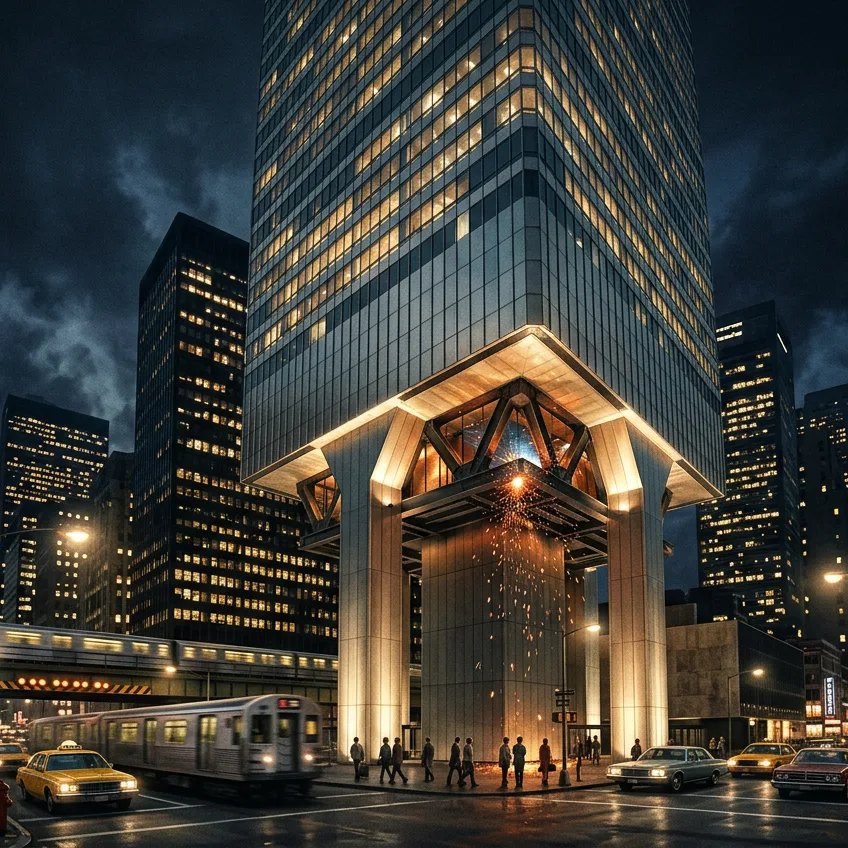
In 1977, the Citigroup Center opened in Manhattan, a 279-meter skyscraper famous for a daring design: to respect a pre-existing church on the same block, the tower did not rest on its corners, but on four colossal pillars located at the center of each facade, leaving the corners suspended in a dramatic cantilever.
A few months after its opening, an engineering student named Diane Hartley contacted the design team with a technical question about how the building handled diagonal winds. Intrigued, the structure's lead engineer, William LeMessurier, recalculated the numbers and uncovered a terrifying reality: during construction, the contractor had replaced the welded joints specified in the original blueprints with conventional bolted joints to cut costs, without his knowledge.
The discovery put the city in jeopardy:
- While perpendicular winds posed no danger, diagonal gusts increased stress on the structural joints by 40%.
- A storm with winds of just 115 km/h—a statistical event expected every 16 years in New York—was enough to shear the bolts and cause the entire tower to collapse onto Lexington Avenue.
With Hurricane Ella moving up the Atlantic coast, a rescue was mounted in total secrecy to avoid triggering mass hysteria in Manhattan. Every night, dozens of welders slipped in clandestinely to weld heavy steel plates over the 212 bolted joints, while by day office workers entered as usual. The structure was reinforced in time and the danger was neutralized, keeping the incident hidden until it became public in 1995.
Source: The New Yorker (Joe Morgenstern, 'The Fifty-Nine-Story Crisis', 1995)