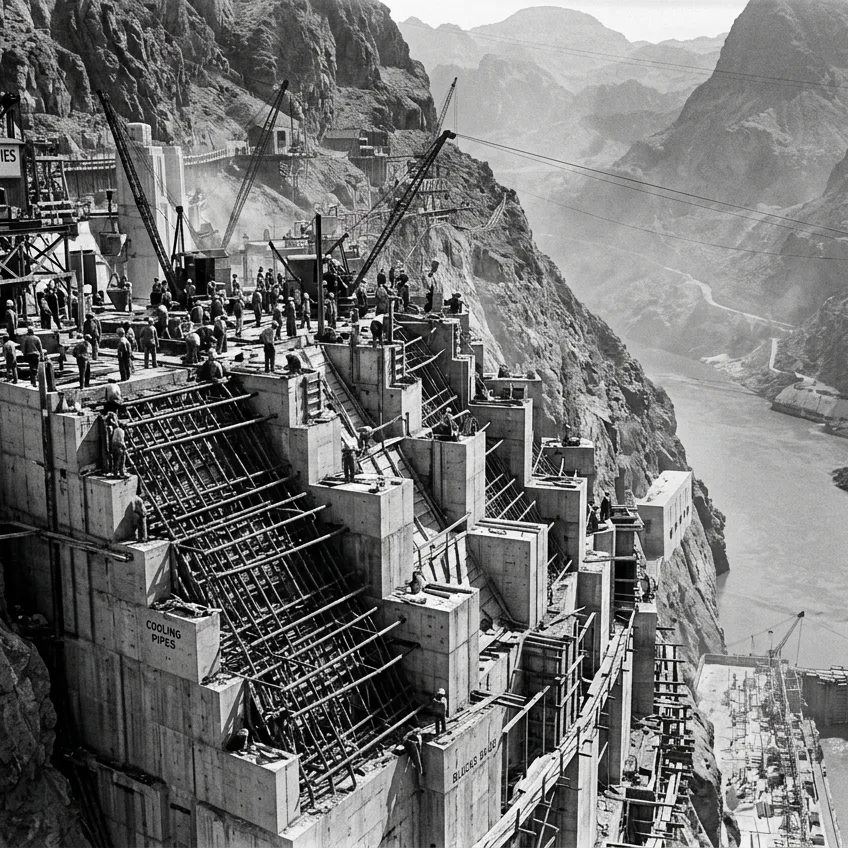
When construction of the Hoover Dam began on the Colorado River in 1931, engineers ran into an unforgiving law of thermodynamics: the curing process of concrete is an exothermic chemical reaction that generates astronomical amounts of heat. The dam required more than 3.3 million cubic meters of concrete, a mass so colossal that, if poured as a single continuous block, the internal heat trap would have taken between 112 and 125 years to cool completely to ambient temperature.
That uneven cooling rate would have triggered monstrous thermal expansion and structural cracks so deep that the dam would have collapsed under the water pressure of Lake Mead. To dodge catastrophe, chief engineer Frank Crowe implemented an unprecedented solution: dividing the dam into hundreds of independent blocks and embedding inside them a network of over 930 kilometers of steel pipes measuring one inch.
Through these pipes, they first circulated cold river water and, later, ice-cold water near freezing point produced by a gigantic refrigeration plant built on-site, capable of manufacturing more than 1,000 tons of ice per day. Thanks to this artificial thermal circuit, the blocks cooled and contracted in a controlled manner within weeks. Once cooled, engineers injected high-pressure cement grout into the intermediate joints, forever sealing an indestructible monolith that still defies the passage of time today.
Source: Bureau of Reclamation (U.S. Department of the Interior) - Hoover Dam History and Construction Data