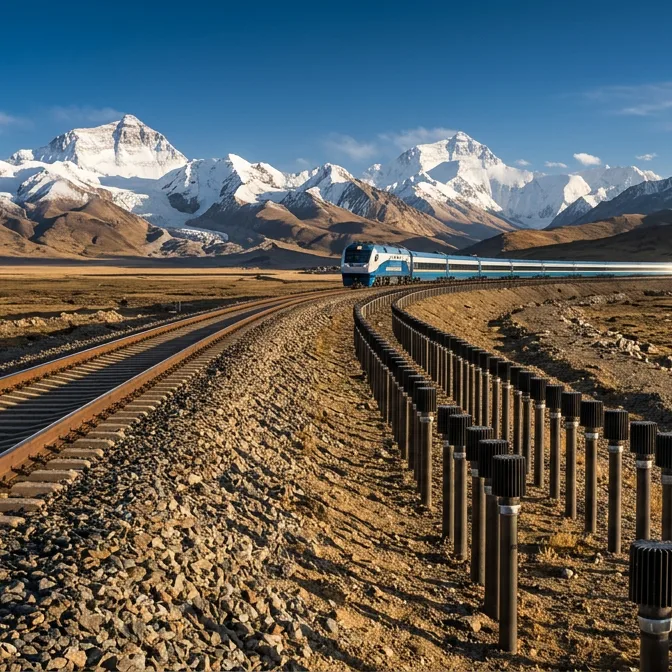
Inaugurated in 2006, the Qinghai-Tibet railway connects mainland China with Lhasa, crossing the Tibetan Plateau at an altitude of more than 5,000 meters. For decades, prominent international engineers considered this route unfeasible, not only due to the lack of oxygen for workers, but because of a geological trap: about 550 kilometers of the route run over continuous permafrost.
Tibetan permafrost is thermally unstable; it hovers very close to zero degrees Celsius. The heat generated by the weight of trains, friction, and solar warming of the gravel embankments threatened to thaw the upper subsoil layer each summer. If this happened, the solid foundation would suddenly turn into shifting mud that would sink the tracks and derail trains.
To overcome this challenge without resorting to a prohibitive electrical refrigeration network in the middle of nowhere, engineers turned to pure thermodynamics, installing tens of thousands of ammonia thermosiphons along the route:
- Passive operation: These are sealed metal pipes driven several meters deep, containing liquid ammonia at their base and dissipating fins exposed to the open air.
- One-way cooling effect: During the frigid Tibetan winter, the deep ground is warmer than the outside air. The ammonia absorbs that underground heat, evaporates, rises to the surface, releases the heat into the atmosphere, and condenses back down to the bottom.
- Thermal trap: In summer, the cycle stops completely because the outside air is warmer than the subsoil, preventing atmospheric heat from penetrating deep underground.
Thanks to this ingenious closed-loop heat circuit, the ground beneath the tracks remains an impenetrable block of ice year-round, allowing pressurized trains to run at over 100 km/h across the roof of the world.
Source: Cold Regions Science and Technology / Chinese Academy of Sciences (State Key Laboratory of Frozen Soils Engineering)