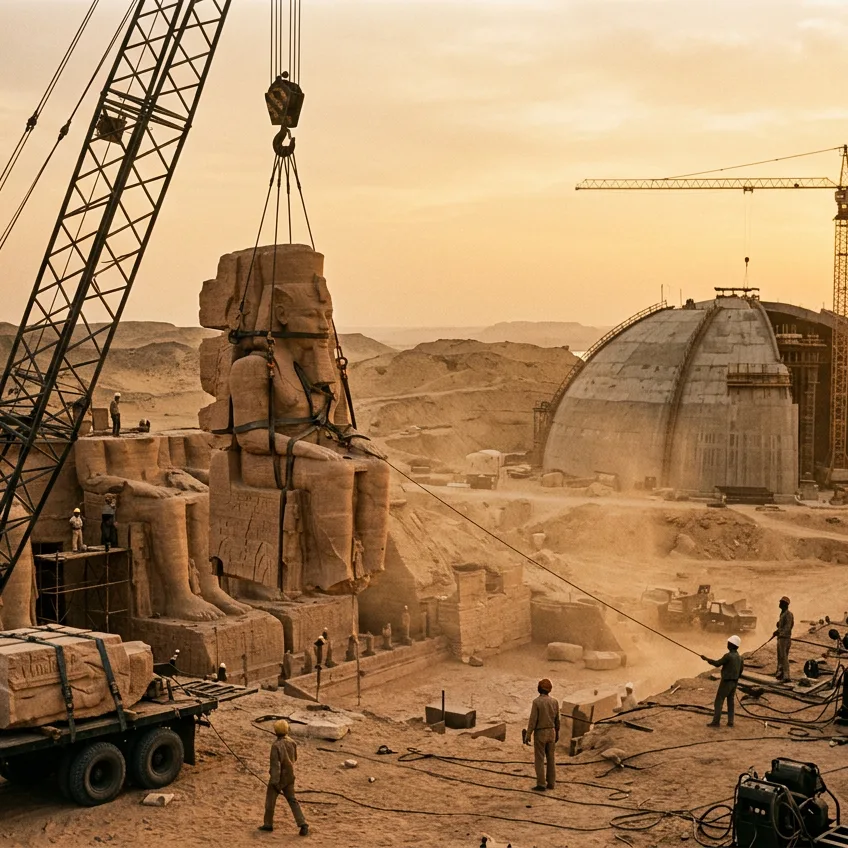
In the early 1960s, the construction of the Aswan High Dam in Egypt threatened to permanently submerge the colossal temples of Ramesses II and Nefertari at Abu Simbel beneath the rising Lake Nasser. To prevent this heritage catastrophe, UNESCO orchestrated one of the greatest civil engineering feats of the 20th century: dismantling two complexes carved directly into the living rock of a cliff and rebuilding them 65 meters higher and 200 meters inland.
Between 1964 and 1968, a multinational consortium of engineers and geotechnical specialists executed an operation of surgical precision. Technicians first erected a protective cofferdam against the rising waters. Next, the rock relief and facades were meticulously cut into more than 1,035 blocks weighing between 20 and 30 metric tons, using manual steel wire saws to avoid causing destructive vibrations in the ancient sandstone.
The reconstruction required unprecedented structural ingenuity: to support the weight of the artificial mountains sculpted around the temples, engineers built two massive reinforced concrete domes over the interior chambers. These self-supporting vaults insulate the sacred ceilings from any structural load. The final assembly was so precise down to the millimeter that it preserved almost perfectly the astronomical alignment through which the dawn rays illuminate the inner sanctuary twice a year.
Source: UNESCO Courier / Official Nubia Campaign Archives (1968)