Across almost the entire planet, the ocean floor is condemned to an inevitable fate: being cold and dense, it sinks beneath continental plates and disappears into the depths of the mantle in a process known as subduction. However, around 90 million years ago, on today's Arabian Peninsula, one of the greatest tectonic anomalies in geological history occurred: obduction.
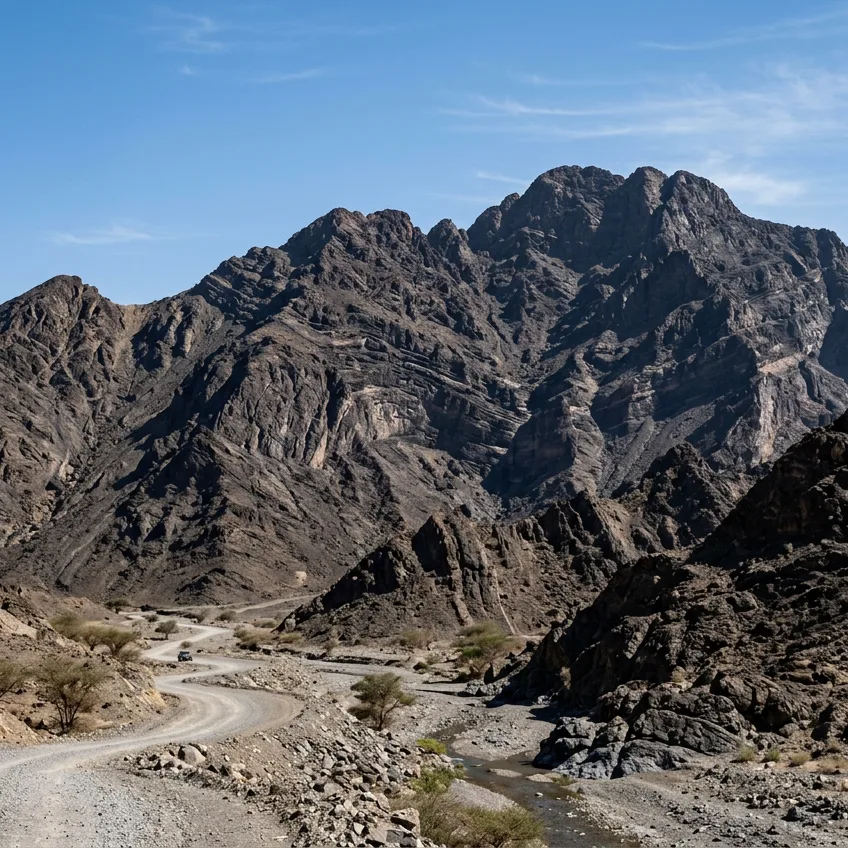
Instead of sinking into the abyss, a colossal portion of oceanic lithosphere measuring nearly 100,000 square kilometers was pushed over the continent, climbing onto dry land. This intact block is the Semail Ophiolite, located in the mountains of Oman and the United Arab Emirates, and it represents the best-preserved fragment of primitive ocean floor on Earth.
Its significance for science is monumental for several reasons:
- Walking on the Moho: It is one of the few places in the world where you can cross on foot the Mohorovičić discontinuity, the exact boundary separating Earth's crust from the mantle, without needing to drill through kilometers of solid rock.
- The anatomy of the abyss: It exposes the complete sequence of oceanic crust on the surface: from pillow lavas that cooled under deep water to volcanic sheeted dikes and layered gabbros.
- A natural carbon sink: Its peridotite rocks actively react with rainwater and air, trapping carbon dioxide through mineralization at such a rapid pace that scientists study them to combat climate change.
What lies buried under kilometers of water and magma anywhere else on the planet stands in Oman as a mountainous desert where you can touch the deep heart of the Earth with your own hands.
Source: United States Geological Survey (USGS) & Nature Geoscience