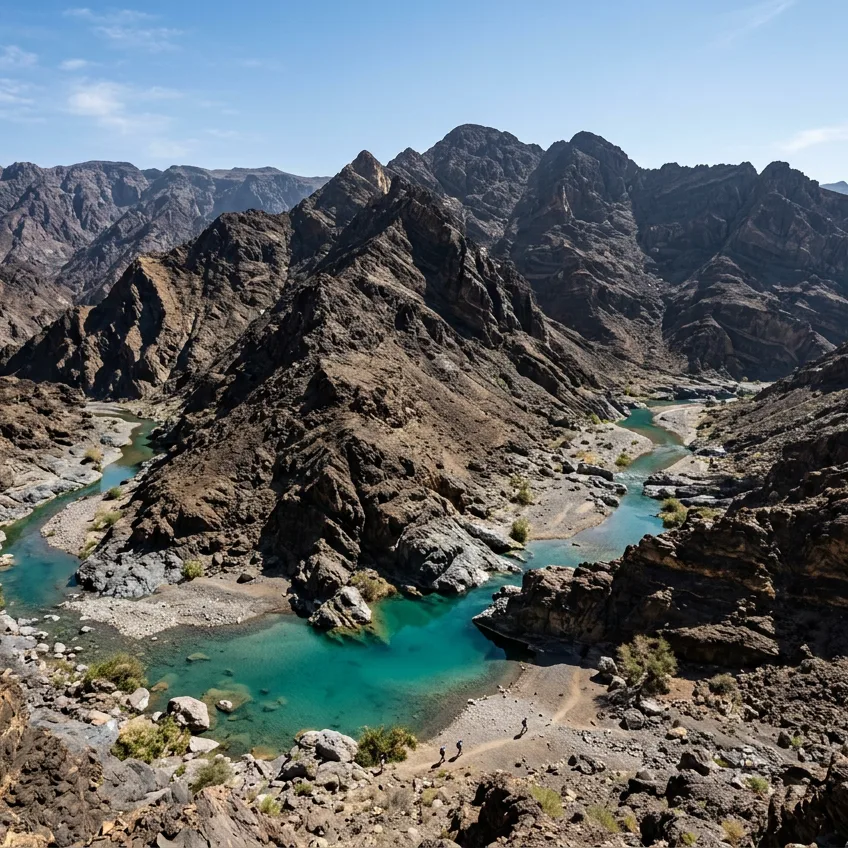
To reach Earth's mantle, humans would need to drill dozens of kilometers through impenetrable crust and withstand crushing pressures and temperatures. However, in the rugged mountains of Oman and the United Arab Emirates lies an unusual place where there is no need to dig even a single meter to touch it: the Semail Ophiolite.
As a general rule, when two tectonic plates collide, the oceanic crust—far denser and heavier—sinks beneath the continental crust and melts deep inside the planet through a process known as subduction. However, about 70 to 90 million years ago, during the Late Cretaceous, geological forces underwent a colossal anomaly called obduction. Instead of sinking, a gigantic fragment of the ancient Tethys Ocean seafloor was pushed upward and shoved onto the continental mass of the Arabian Plate.
The result is a strip nearly 500 kilometers long and up to 15 kilometers thick that exposed a perfect cross-section of Earth's interior:
- Pillow lavas forged under thousands of meters of seawater.
- Sheeted dike complexes and gabbros that formed the ancient middle and lower oceanic crust.
- Upper mantle peridotites, rich in olivine, fully accessible under the desert sun.
Today, this area is the planet's largest open-air geological laboratory. In addition to revealing Earth's internal structure, its magnesium-rich rocks are actively reacting with air and groundwater through a process of serpentinization, naturally absorbing thousands of tons of carbon dioxide per year and converting it into solid carbonate.
Source: Geological Society of America (GSA) & The Oman Drilling Project