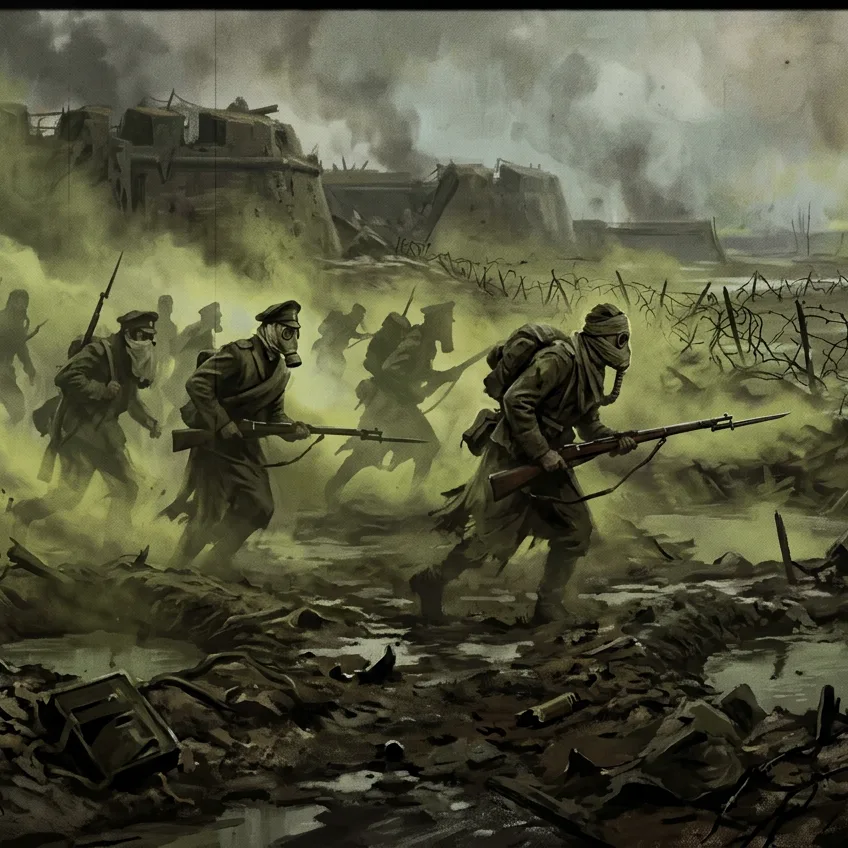
On August 6, 1915, during World War I, the German army unleashed a chemical inferno on the Russian fortress of Osowiec, located in present-day Poland. After weeks of fruitless siege, German sappers opened dozens of cylinders containing a highly concentrated mixture of chlorine and bromine. A favorable wind carried a dense wall of gas twelve meters high that withered grass, blackened foliage, and rusted metal in its path. The Russian defenders lacked standard-issue gas masks and could barely protect their faces with rags soaked in water or their own urine.
Convinced that the entire garrison had perished, fourteen German battalions—comprising more than 7,000 infantrymen—advanced confidently to take the enemy trenches, expecting no resistance. However, as they approached the first defensive line, they witnessed a spectacle straight out of a nightmare: out of the thick greenish fog emerged around sixty surviving Russian soldiers from the 13th Company of the 226th Zemlyansky Regiment.
Covered in chemical burns, wrapped in bloodstained rags, and coughing up pieces of their own lungs dissolved by hydrochloric acid formed in their airways, the defenders did not surrender. They fixed their bayonets and charged the invading forces with suicidal ferocity. The psychological terror of facing what they believed were resurrected corpses triggered immediate mass hysteria among the German ranks; the retreat turned into a chaotic stampede where hundreds of soldiers tripped and were crushed to death on their own barbed wire entanglements.
Source: Kauffman, J. E., & Kauffman, H. W. (2016). Fortress Europe: European Fortifications of World War I. Pen & Sword Military.