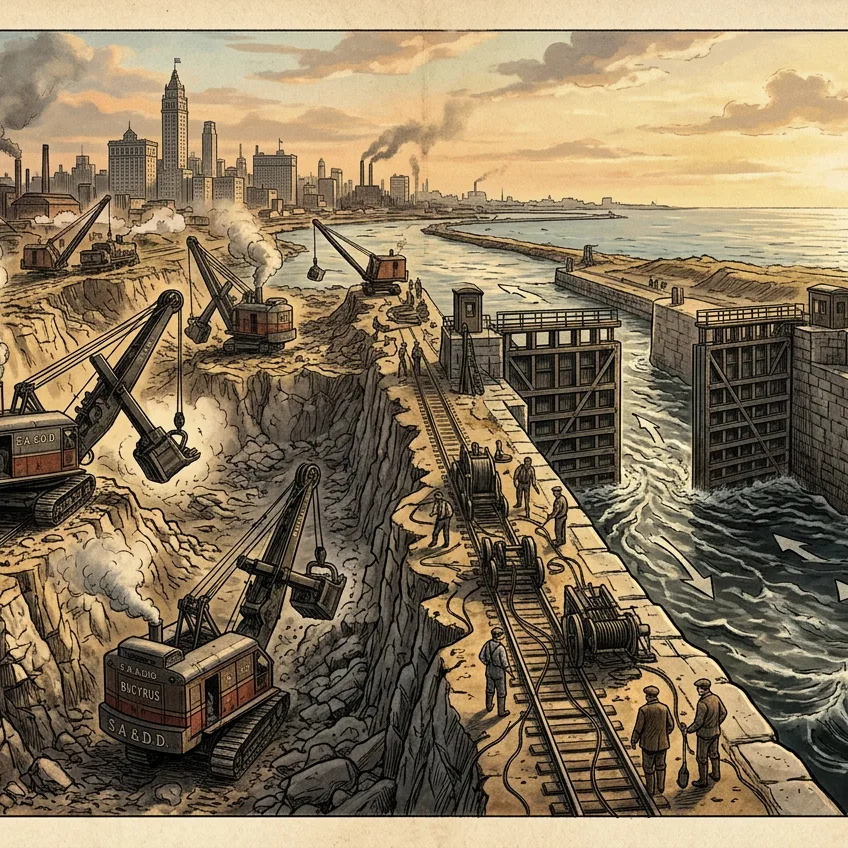
At the end of the 19th century, the booming city of Chicago faced a severe public health crisis. All of its sewage and industrial waste emptied directly into Lake Michigan, the primary source of drinking water for over 1 million residents. The result was deadly: recurrent epidemics of typhoid, cholera, and dysentery threatened the future of the metropolis.
The proposed solution verged on the impossible for the era: forcing an entire river to flow in the opposite direction. To achieve this, between 1892 and 1900, the Chicago Sanitary and Ship Canal was constructed, a colossal 45-kilometer trench connecting the Lake Michigan basin with the Mississippi River valley.
Engineers excavated the canal below the elevation of the lake. Thus, through pure physics and gravity, clean water from Lake Michigan began rushing into the riverbed toward the continent's interior, permanently reversing the river's course toward the south.
The project marked several historic milestones in modern engineering:
- Over 30 million cubic meters of rock and earth were removed, serving as a large-scale technological trial that perfected the excavation machinery used years later in the Panama Canal.
- Facing an impending judicial injunction from the state of Missouri, which feared receiving the sediment in St. Louis, engineers secretly breached the final earthen dam in the early hours of January 2, 1900, before receiving the federal stop-work order.
Named by the American Society of Civil Engineers as one of the civil engineering monuments of the millennium, this intervention prevented millions of deaths and redesigned North American hydrology forever.
Source: American Society of Civil Engineers (ASCE) / Chicago Sanitary District