For centuries, the acqua alta phenomenon periodically flooded St. Mark's Square and Venice's historical foundations. To protect the iconic city without altering maritime traffic or ruining the lagoon's landscape, engineers ruled out building visible permanent dikes and created the MOSE System (Electromechanical Experimental Module), one of the greatest hydraulic engineering feats on the planet.
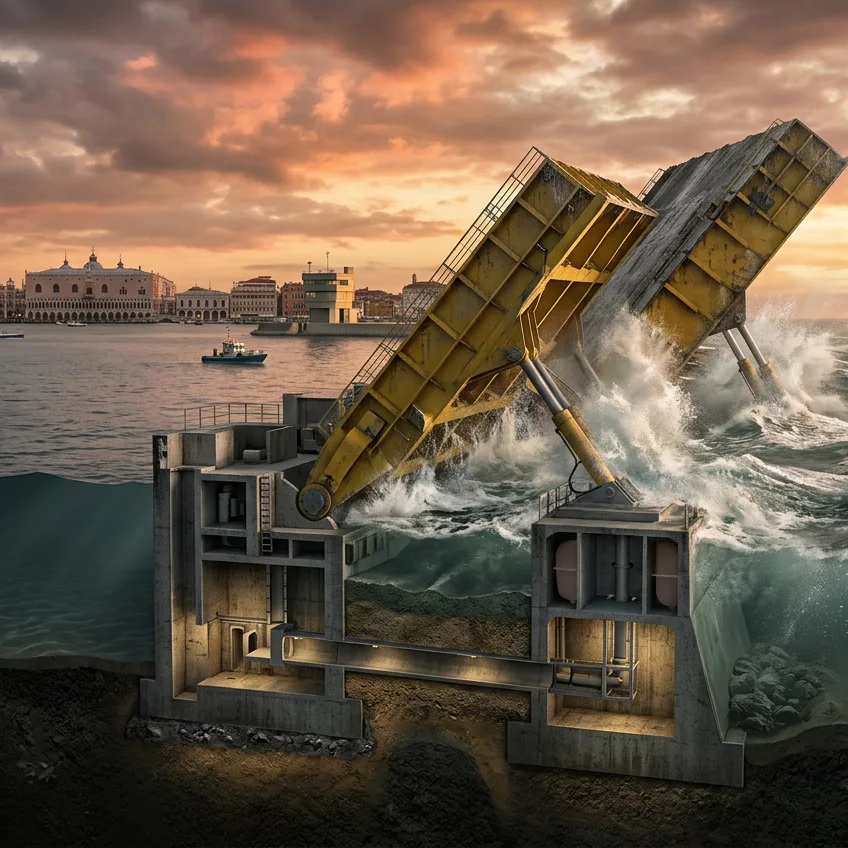
The system consists of 78 gigantic metal floodgates, each up to 28 meters long and weighing 300 metric tons, installed in submerged concrete caissons at the three inlets connecting the lagoon to the Adriatic Sea (Lido, Malamocco, and Chioggia). Under normal conditions, these massive barriers remain invisible and filled with seawater, resting horizontally on the seabed.
When sensors detect that the tide will exceed 110 centimeters, the mechanism is activated: high-pressure compressed air is injected inside the panels to expel the ballast water. Becoming hollow and buoyant, the gates rotate on underwater millimeter-precision hinges and rise in about 30 minutes at a 45-degree angle, creating an impassable wall against the sea.
- Total isolation: The barriers can hold back sea-level differences of up to three meters between the Adriatic and the lagoon.
- Independent operation: Each gate operates autonomously, making it possible to modulate water flow or withstand extreme waves.
When the sea level drops, the air is released in a controlled manner, water flows back in, and the gates return to their dormant state on the seabed, restoring free navigation and biological exchange to the Venetian lagoon.
Source: Consorzio Venezia Nuova / American Society of Civil Engineers (ASCE)